
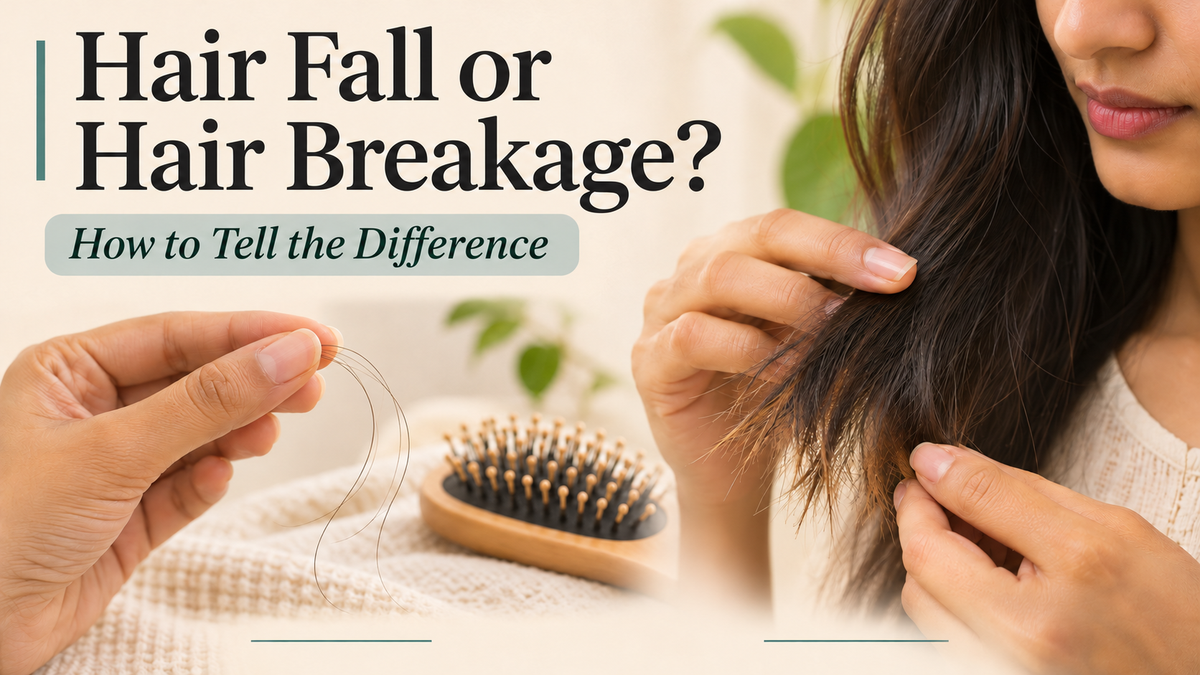
Finding more hair on your comb can be worrying. Before changing your shampoo or buying a hair-growth product, it helps to look at what you’re seeing. Are whole strands coming out, or are pieces snapping off?
Both can make hair look thinner, but they happen for different reasons. The right care starts with understanding the difference.
What is the difference between hair fall and hair breakage?
“Hair fall” is an everyday term that can describe several kinds of hair loss. Here, we’re using it to mean shedding: a strand is released from its follicle as part of the hair-growth cycle.
Breakage happens along the strand itself. The hair snaps, leaving part of it still attached to the scalp. You may notice shorter pieces in your brush or uneven lengths through your hair.
Shedding and breakage can happen together, so the distinction is not always obvious.
|
What you notice |
More consistent with shedding |
More consistent with breakage |
|
Hair in your brush |
Whole strands, often close to your usual hair length |
Shorter pieces of different lengths |
|
Appearance of your hair |
Less overall fullness if shedding is excessive |
Uneven lengths, frayed ends or difficulty retaining length |
|
Where the problem happens |
The strand is released from the follicle |
The strand fractures somewhere along its length |
These are clues, not a diagnosis. A short hair could also be new growth, and some scalp conditions can cause broken hairs.
Why might you be shedding more hair?
Some shedding is normal. Seeing loose strands after washing or brushing does not automatically mean something is wrong.
A noticeable increase can follow an illness, high fever, surgery, childbirth or a period of significant stress. With a condition called telogen effluvium, the extra shedding often appears a few months after the trigger. That delay can make the cause difficult to connect with what is happening now.
Other causes of thinning, including inherited hair loss, need a different assessment. Don’t assume that every increase in hair fall is temporary.
What causes hair to break?
Hair can become fragile through repeated heat styling, colouring, bleaching, chemical straightening or rough handling.
Everyday habits matter too. Pulling a comb through tangles, rubbing wet hair vigorously with a towel and repeatedly wearing tight hairstyles can put stress on strands. You may notice that the ends look thin even though your roots seem fuller.
Tight hairstyles deserve particular attention because repeated pulling can also damage follicles and cause traction hair loss.
What can you check at home?
Look at a few hairs that have already come away during normal washing or brushing. There is no need to pull out strands to test them.
Notice whether they are mostly long hairs or small fragments. Think about recent changes as well. Have you started straightening more often? Had a chemical treatment? Been unwell in the past few months?
A photograph of your parting and hairline can help you record changes. Use similar lighting and the same angle each time. Bring those photographs, along with a brief timeline, if you see a dermatologist.
Avoid judging everything from one wash day. The more useful question is whether your hair’s fullness, condition or usual shedding pattern has changed.
What helps if your hair is breaking?
Start by making washing and styling gentler.
Massage shampoo into the scalp rather than scrubbing the lengths together. Use conditioner after shampooing, and ease out tangles without tugging. Blot or wrap your hair in a towel instead of rubbing it roughly.
Reduce how often you use straighteners and curling tools. When blow-drying, use a low heat setting. Give your hair a break from tight ponytails, buns and styles that pull.
Detangling also depends on hair texture. Straight hair can be allowed to dry a little before gentle combing; tightly curled or textured hair is generally better detangled while damp with a wide-tooth comb.
Will changing shampoo stop hair fall?
A shampoo may help you manage cleansing or a particular scalp concern, but choosing a product without understanding the cause can leave the main problem untreated.
If you’re comparing products, our guide to choosing a shampoo for hair growth and thickness offers further reading on shampoo selection.
Conditioners and detanglers can reduce friction and help limit breakage. Excessive shedding or progressive thinning may need an assessment of your health, scalp and medical history.
The same caution applies to hair supplements. A deficiency may need treatment, but taking extra nutrients without a reason is not a reliable solution. Too much of certain nutrients can contribute to hair loss.
When should you see a dermatologist?
Arrange an appointment if you notice bald patches, a widening parting, rapid thinning or shedding that continues to concern you. Seek advice sooner if hair loss comes with scalp pain, redness, scaling or pus.
If you also have itching, flaking or irritation, our Scalp Care 101 guide covers everyday scalp care. Persistent symptoms still need a dermatologist’s assessment.
A dermatologist can examine both the scalp and the strands to work out whether you have shedding, breakage or a combination. Depending on your history, they may consider tests for causes such as iron deficiency or a thyroid condition.
Before choosing your next hair-care product from Atomic Pharmacy, take a moment to identify what you need help with: cleansing, detangling, damaged lengths or a diagnosed scalp concern. That gives you a clearer starting point than choosing a bottle simply because it says “hair fall.”
For seasonal care advice, you can also read our winter skin and hair care guide.